Wednesday, September 21, 2011

A Filipino Family Experience

A family outing to Eden Park
We were one big happy family. Over the 3 weeks that it took to complete our diving courses we were invited to stay in our Divemaster's home. It was a very full and busy house, ten of us under one roof; Divemaster Frank, Mari Lou, Cozette and I, and the six children, Jakie, Jayare, Javina, Kei, Mako, and Lahia.


The Lovely Mari Lou

We didn't expect to stay more than a week, but Mari Lou, our most gracious hostess, had other plans for us. She took the liberty of being our personal guide and planned everyday with things to do and places to visit. When we were not diving, she made sure we were comfortable, stuffed full of delicious food, and had an itinerary as to not miss any of the sights around Davao. When Frank got ill it put a hold on our schedule for a few days, then Cozette and I took turns being sick.This all threw kinks into our dive plans and prolonged our stay, but we were assured that we were welcome, everyone was having a good time.


Somewhere over the rainbow...
The rare Mako fish!

The ten of us went to the beach or to a park on the weekends for "Family day". At night us "adults" would go out to restaurants, for a massage, or to the disco. All locations were preselected by Mari Lou. Frank and Mari Lou were very stubborn about letting us share the cost of our outings. We had to be very sneaky to slip our money into a restaurant bill or to pay for a taxi fare. Frequently we were told by a waiter that the bill was pre paid before we had ordered. Sneaky, sneaky, Mari Lou!


  When we had finally finished our diving and it was  time to leave, it was hard to say good bye to our new Filipino family. One of the children asked, "Will you stay? Or come back soon? Maybe in November?". Afraid not...  So a piece of our hearts remains in Davao City in southern Mindanao. Some day we may reunite, but our time together will be remembered forever.

A Day of Diving

After surfacing.  In the back ground: The Ann-Lise 3 and the Davao Dive Crew.
We finished our Advanced SCUBA dive training off of the coast of Samal island in southern Mindanao. The water was clam and the sun shined as we floated lazily across the channel on the Ann-Lise 3. Three dives were planned to wrap up our advanced certification.The first dive of the day was a "deep dive", a dive exceeding 25m, 82ft.  We plunged into the blue, quickly having more water above us than ever before. It was an uneventful dive, if there can be any such thing. We observed fish and swam about. Colors all fade. Red is washed out before 20ft followed by orange, yellow and green. Below 70ft everything, corals, and fish are all shades of blue and purple. Decompression sickness or "the bends" is a factor to account for when diving at these depths. It occurs because the nitrogen that is mixed with the oxygen in your air tank gets forced into the cells of your skin tissue over the duration of the dive. At 30m the pressure is 4x greater than on the surface. What this means is that if you stay down too long, or ascend too quickly, not allowing enough time for the nitrogen to leave your cells and be exhaled, it expands to 4x it's volume. This Hurts! One can imagine having intense internal pain under your skin from these expanding bubbles. Don't worry it didn't happen to us. Using a simple table to factor depth and time we can plan dives to avoid this painful experience. We ascended casually to the boat and ate lunch.
At 25m, 82ft below the surface.

The second dive was a search and recovery dive. This dive is used for finding lost items, a pair of keys, for example, that have been dropped over board. Using a compass we navigated a couple different search patterns. One was an expanding spiral and the other an alternating "U" search pattern. It was damn difficult too, with the current constantly pushing us sideways off of our line of direction. It takes a lot of practice to be anything more than awful at navigating underwater. We had to first review navigation above water before we had any chance at being successful below. We also practiced swimming at mid level in the water. With no line of reference, too far from the bottom and too far from the surface, it's very easy to become disorientated. There's nothing to judge your speed or direction, only limitless blue. If it weren't for the bubbles you wouldn't know up from down. With air running low, back up to the boat we went.

Cozette with her new snorkel and goggles.
Our final dive as students was a night dive! The sun fell into the water and we began to follow its example. We prepared our dive torches, attached extra lights to our gear and suited up. nervously we descended into the black water. Down, down, down, only blackness until the bottom. The Corals open up more at night, some fanning out into the surrounding water. Despite the depth, colors appeared vividly bright in the light of our torches, punctuated by the contrast of the dark water. Most fish were hidden away in their cracks and crevices to escape nocturnal predators like octopus. Some fish were active though, kinds you can only see at night, the "second act", as our divemaster put it. The darkness added a certain mysteriousness and an eerie, alien-like feeling to the sea floor. I felt like I was exploring the surface of a distant planet, expecting to see some unrecognizable creature come floating towards me out of the darkness. A twinge of claustrophobia is felt from the encasing blackness in all directions, similar to what I have felt only inside of a cave. We covered our lights and enjoyed the show, millions of bio-luminescent plankton flashed sparks of green in the water around us, The lightning bugs of the sea. Just as the current began to get very strong, we found the boat's anchor line and ascended one final time as dive students. Aboard and exhausted from the long day, we drank hot coffee and cruised back to the port and home. Food, shower, sleep and dreams of future diving.

Check out our dive school on Facebook!  Davao Scuba Dive

Friday, August 26, 2011

Salamat Davao

I had some very cool pictures that would have accompanied this blog post but I forgot my flash drive in a public internet cafe and now they are gone... You live and you learn I suppose. I'll write anyway...

The city of Davao is on the island of Mindanao, the southernmost "main" island of the Philippine archipelago. Davao is the second largest city in the world in terms of land area. There are many things to do around the city. To the south stands Mt. Apo, the highest peak in the Philippines at 2954 meters or 9692 feet. To the east, an ocean playground, and all around, friendly people and good food.

The small island of Samal, a short ferry ride across the channel, is home to the World's largest colony of Geoffrey's Rousette fruit bats. The smell  is worth the experience. Millions of tiny winged rodents chatter as they hang throughout the day in the caverns, five or six skylight openings allow a view of the bats. Every inch of the cave wall is occupied by a little snout nosed bat and mothers may hold a little one under their wings. The bottom of the cave, as expected, has been filled up with excriment from it's nocternal residents. When the breeze blows the right way a warm, thick, can I say sweet?, aroma finds it's way to your nose. On the way out of the viewing area we spotted the "princess bat", the colony's only albino member, a small white spot in a sea of brown.

 We have taken advantage of the cheap rates and have enrolled in the PADI Open Water Scuba course. For only 13,500 Pisos ($321 US) and four full days of diving and studying, you can have a life-time dive certification. The ecology and environments under the surface reveal themselves as both thrilling and meditative. The Philippines lays right in the middle of the "Coral Triangle". This is the area most densely populated with corals, and therefor, extremely biologically diverse. In the past year, 50 new species of sea slug, a sea star who only feeds on decaying drift wood, and a deep water shark who swells to fend off predators, have been discovered in the Philippine archipelago. When we dive, the reefs come in to view displaying multicolored corals, giant sponges of varying shapes, fish of bright colors and amusing shapes, and alien like crustaceans. Underwater photography interests me as a possible future pursuit. The ocean floor is a totally different world from the one we walk and it's such a privileged to have the means to visit it, if only for the duration of the air on my back.

 In Davao, a culinary hot spot, one can visit any number of  markets where fresh fish, chicken, beef, pork, vegetables, fruits ect. can be bought. Rows of open air stalls fill a huge warehouse like space. Fish and meat is laid out over ice that has been shaved and broken off of large, delivered blocks. The quickly melting ice, the smell of fish, and the pairing of the words "open air" and "meat", may be enough to scare away a lot of people wary of health risks. I was cautious at first too, but was quickly assured by our native Davao host and guide, Mary Lou, that the meat is the freshest cut and the fish, the freshest catch you can find. "They will not have a chance to go bad before we prepare them." We bought fresh squid, green oysters, live crabs, the largest shrimp I've ever seen, and a whole chicken. Outside we hopped on the back of three motorcycle taxis, bags in hand and weaved our way through traffic. When we got home Mary Lou fixed the feast and we enjoyed every last bit.  Cheap, fresh and delicious.

The Kadayawan Festival is a large festival held every year in Davao in August. It started when local tribes came together to celebrate the bounty of the years harvest. Now it's just a big week long celebration with parts of the past interwoven. The Festivities climax with a huge parade and a tribal dance competition. Colorful costumes inspired by bright flowers are worn and floats are adorned with plants and flowers. People eat, drink and dance all night, (as they seem to do anytime of the year) and schools and businesses are closed. This festival is only held in Davao. Every other province has it's own festival, some celebrating harvest, fishing seasons, or saints. It doesn't take much to get people to celebrate in the Philippines, and why should it? Life is a celebration!

I will miss the fun here in Davao and will take the memories with we to the next great place. Salamat, "Thank you"- in Filipino, Davao! Your people, atmosphere, food and way of living make it hard to leave. 

Wednesday, August 17, 2011

Good MorningThe Philippines!


Makati City, Manila, The Philippines
Waking up in the City of Manila is like being in the New York of the Philippines. With 16 million people it is a bustling capitol and economic center during the day and reveals itself as a non-stop sprawling party scene when the sun goes down. The locals are fun, hospitable and they all seem to have rhythm!

Wide variety of fresh street food
Jeepneys, a major source of public transportation, were converted from US jeeps left over from WW11
 The streets are full of a variety of Asian foods from Thai to local fresh fish and soups. You can find just about anything to satisfy a hungry traveler. If your feeling gutsy try a local Filipino delicacy, Balut - a fertilized, half developed, boiled duck egg!

If that's too much for your eyes or gut to handle just stop for a bite at Jolibee, the Philippine's most popular fast-food restaurant. Although the Manila area is the most costly area of the country your money can still go a long way. A filling meal anywhere should not cost you more than 300 Piso ($7USD) per person. And the Philippines is home to "The World's Cheapest Beer", San Miguel. If the all nighters of dancing and eating don't completely wear you out, hop on a Jeepney or catch a cab to explore the rich history of the city. Visit Intramuros, the the Spanish walled city built during the Spanish Colonial Period in the 16th century.Walk through Rizal park or find any number of useful and novelty items at the market in Old Manila. When it's time to get out of the city hop a cheap flight to one of the southern provinces and be on the beach before you know it.


With a Guard dressed in Spanish Colonial era uniform


Friday, August 12, 2011

Aloha and Mahalo Maui

After we finished house sitting for Kelly and Allan Cozette and I set out on a mission to see the remaining eastern shore of the island we had not gotten to yet. From the house in Haiku we hitched up to the 10,000 ft summit of Haleakala, House of the Sun, "the world's largest dormant volcano". The road to the top from sea level to summit is only 37 miles, ending above the clouds. From there we spent three days packing across the crater floor and descending down the Kaupo Gap on the eastern side of the National Park.

Yellow Line Shows Our Route.


Once we reached the Kipahulu area on the eastern coast we camped for a couple of nights before continuing through Hana and back around, Northwest, to complete our circuit. The trip took a total of 6 days and was a great end to our stay on the island. We managed to circumnavigate the entire island while we were there for our month and two weeks, seeing everything there is to see on a backpackers budget. From our calculations we spent roughly $500 each while on the island, including concert tickets and a couple of nights eating out. Not bad considering Maui will probably be the most expensive leg of our trip.

Here are the pictures from our last bout of backpacking around up and over Haleakala and around the Eastern coast.

The 'Ahinahina, "Silversword" is found in the Haleakala crater and nowhere else in the world. It's leaves are covered in small silver colored hairs to reflect sunlight and retain moisture. It is a member of the Asteraceae or sunflower family.

Areas of the crater floor are devoid of life. No plants, insects or animals are found here. It is uncomfortably silent. It's rarely windy and on calm days scientific instruments used to measure sound have read zero decibels.
In such a lunar scape we thought it appropriate to take gravity defying pictures.
Near the Paliku camp. On the other side of the ridge is a restricted tropical rainforest preserve.
Views of the ocean coming down the 7000ft decent of the Kaupo Gap.
The steep 8.6 miles to the coast was hard on our knees and feet, but worth the view.

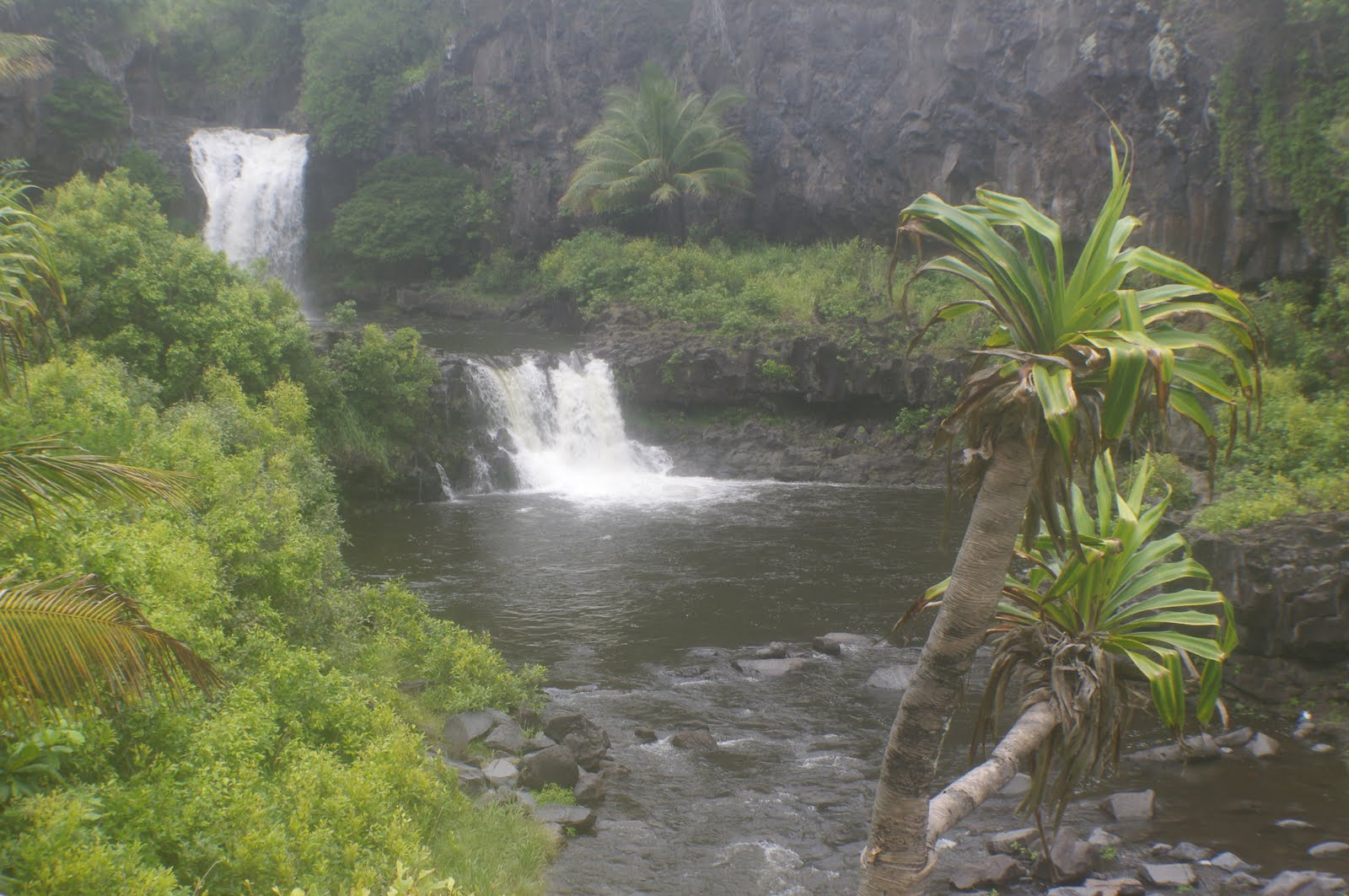
When we made it to the coast we camped for two days and played in the pools before continuing through Hana and completing our circuit.
The "Seven Sacred Pools" are formed in a gulch as the rain water flows down the mountain out of the rain forest valley.
The pools are right where the steam meets the ocean. The top pool at the largest waterfall has been carved out to a depth of 40ft!

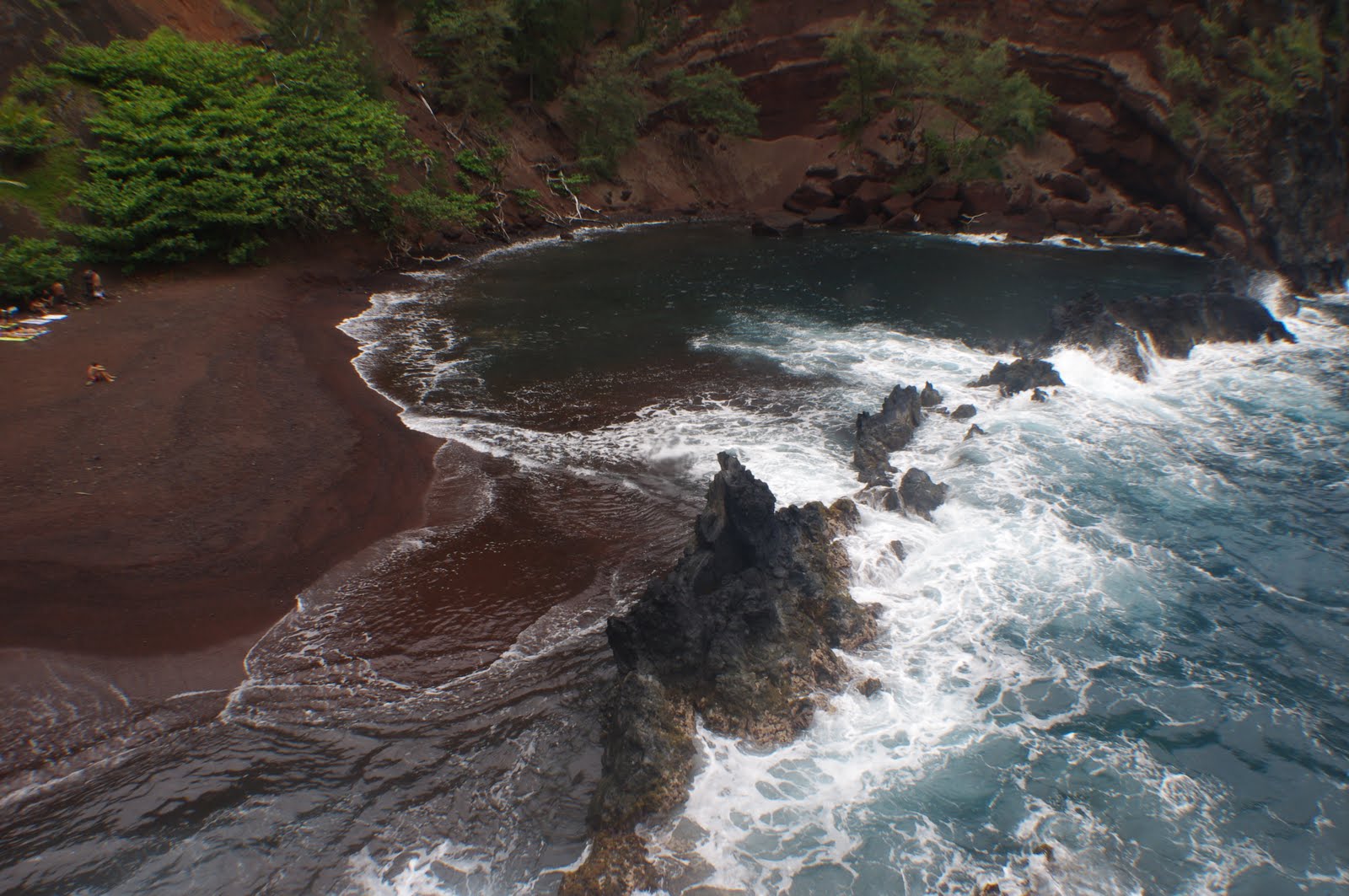
A beautiful red sand beach with clear blue water and a perfect wave break made for good swimming. In Hana.
You enter the cave by swimming a little ways under water. The cave extends 800 ft back or so.


Enhanced by Zemanta